|
 
The
Land
The People
The Government
The
Land
Botswana is a land-locked
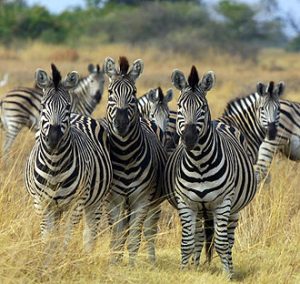
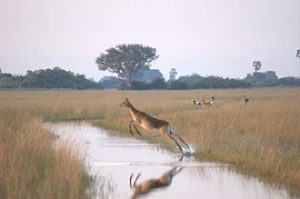
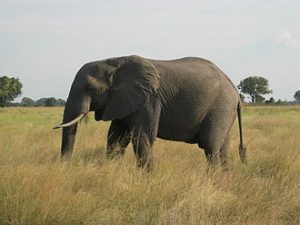
nation centred in Sub-Saharan Africa with an impressive biodiversity
comprised of both desert (the Kgalagadi / Kalahari of central and
western districts) and wetlands (the Okavango Delta and Chobe region
of the north). This region of 600,370 km2 is encircled
by the neighbouring nations of Namibia to the west, Zambia to the
north, Zimbabwe to the east, and South Africa to the south.
Botswana's terrain is
predominantly flat with gently rolling hills and occasionally rocky
tablelands, its highest point reached at the Tsodilo Hills (1,489
m). The country's climate is semiarid, and the Kalahari Desert is,
thus, characterized by plentiful bush flora and fauna.
As in all of Africa,
land sustains life. Botswana's natural resources - diamonds, copper,
nickel, salt, soda ash, potash, coal, iron ore and silver - generate
much national revenue, particularly in the diamond mining industry.
Cattle-rearing is the most significant agricultural enterprise.
Small farmers rely on cattle, goats, sheep, maize, sorghum, beans,
peanuts, cottonseed and other dry land crops. Beef exports to Europe
represent Botswana's second largest income generator, and the booming
tourism industry, currently third, may soon overtake the beef industry
as the nation seeks to diversify its economy.

The
People

Botswana's
main income generator - diamond mining industry
|
Botswana's massive terrain
boasts, in proportion, a relatively small population of only 1.6
million people (2001 Census results pending), the settlement of
which is mostly concentrated in the eastern reaches of the country.
The people of Botswana - Batswana (plural) - identify with numerous
local ethnic groups such as the Bangwato, Bakgatla, Bakwena, Batawana,
Bakalanga, Batswapong, Barolong, Bangwaketse, Bayeyi, Basarwa, Bakgalagadi,
Babirwa and Baherero. The nation's colonial status as a British
Protectorate until 1965 introduced English as Botswana's official
language. Setswana and its myriad dialects, however, are maintained
as the national language of Botswana and are being used increasingly
in government and official business.
Botswana, like all developing
nations, has faced increased urbanisation in recent decades. The
traditional lifestyle of migration amongst three homesteads - the
cattlepost (moraka), the lands (masimo) and the village (motse)
- has now evolved to include urban lifestyle and settlement. Roughly
half of the nation's population works and lives (at least part-time)
in towns like Palapye, Mahalapye, Selebi-Phikwe and Francistown,
and particularly in Botswana's growing capital city, Gaborone.
Botswana, having negotiated
its independence from Britain, has enjoyed relative peace and harmony
amidst neighbouring countries that took up arms for freedom. Batswana
are still known for peace in the region, but the nation, nevertheless,
now also faces the contemporary and potentially divisive challenges
of tribalism, xenophobia, and globalisation.
A visitor to Botswana
will encounter the beautifully animated traditions of Setswana dance
and song, mud dwellings with thatched grass roofs, and traditional
meeting places, or dikgotla. The village landscape is characterised
by many cattle kraals, for the majority of Batswana continue to
rear cattle according to tradition. Setswana traditional religion
centres on such a connection with the ancestral gods, or badimo.

The
Government

Statue
of the first Botswana's President - Sir Seretse Khama in front
of the Parliament
|
The modern government
of Botswana is best described as a democratic, multiparty system
with executive, legislative and judicial branches. The President,
His Excellency Festus G. Mogae, is both the chief of state and head
of government. This head of state is elected for a five-year term,
the next elections to be held in October of 2004. Botswana's parliament
is bicameral, which is comprised of the House of Chiefs and the
National Assembly. The former is a fifteen-member body consisting
of chiefs (dikgosi) of the eight tribes recognised at independence
with an advisory role on matters of custom, culture and tradition
to the latter, a National Assembly comprised of forty-four voting
members. Since Botswana's independence in 1966, a single political
party has been in power - the Botswana Democratic Party (BDP) -
under the leadership of three presidents: Sir Seretse Khama, Sir
Ketumile Masire and the current President Festus Mogae.

|
|
STATISTICS
Head
of State, His Excellency, President Festus Mogae
Population
1,67 million
Capital
city Gaborone
Total
surface area 581, 730 km2
Urban
population 49.7 %
Life
expectancy at birth 47
Real
GDP per Capita (Pula) 3845
Real
GDP per Capita (PPP$) 7690
Gross
Domestic Investment 38 % of GDP
Gross
Domestic savings 26.6% of GDP
Unemployment
15.8
47%
of population below national income poverty line
51
% of households own cattle
6.4
telephones per 100 persons
273,000
cell-phone subscribers
Elections
held every 5 years
3
parties currently hold seats in parliament
5
parties contested 1999 general elections
Botswana
Democratic Party won 82.5% of seats
77.1%
of eligible voters voted in the last election
18.2%
of Members of Parliament are women
12%
of population without access to health facilities
29%
of sexually active population HIV positive
Annual
condom distribution 8.7 million
Adult
illiteracy rate 25.6%
Primary
school enrolment rate 98.4%
19%
teenage pregnancy
Infant
mortality rate per 1,000 births 48.0
77%
of population have access to safe water
Botswana
is ranked 122 on the Human Development Index
|
|